

The Boxer Codex's Spanish-Chamorro Transoceanic Encounter
The Boxer Codex is a Spanish colonial manuscript that refuses to introduce itself in the usual way. No title page, no author's signature, no clear audience. Instead, it opens with an image that functions like a prologue.

"The document itself remains untitled, unsigned, and undated, generating a permanent enigma about its authorship, potential collaborators, and the historical context in which it was created." (Serratos 526)
"In stark contrast to conventional Spanish manuscripts, this document lacks customary structural elements such as a title, date, and notably, an introduction of the author." (Serratos 527)

This illustration works like a visual preface, even a miniature summary of colonial encounter, because the manuscript opens with image before any explanation.

"The illustration not only depicts the emerging landscape of the Far East as both reality and thematic cornerstone of the manuscript but also serves as a symbolic epitome––almost a rhetorical summary––of coloniality itself, encapsulating the transpacific encounter and conquest in miniature." (Serratos 528)
The Boxer Codex consists of 612 pages—97 featuring color illustrations, 318 containing written text, and 197 left blank.

"The illustrations depict a wide spectrum of individuals, ranging from Afro-Asiatic figures to indigenous peoples, representing diverse social strata and engaging in various occupations predominantly within the Philippines and China." (Serratos 525)
Following the anonymous introductory image, the manuscript features two full-page portrait illustrations of human figures. In the first, a figure appears within a decorative border, accompanied by a gold inscription in the upper left corner bearing the term "Ladrones," the label used by the author to identify the Chamorro community.


Immediately after these visual illustrations appears a Spanish narrative titled “Relación de las yslas de los Ladrones” [An Account of the Ladrones Islands].


"The unknown author of the narrative explicitly states that the individuals aboard the small boats depicted in the image originate from the Ladrones Islands, offering a definitive identification of their origin." (Serratos 529)
"Ellos salen dos tres leguas a la maren unos navichuelos chicos y tan estrechos que no tienen de ancho de dos palmos y medio arriba, son de la forma que ahí van pintados." (f. 3r, emphasis added)
"Within the entire manuscript, this represents the singular occasion when the author makes an intertextual reference to the introductory image." (Serratos 529)
The Spanish-Chamorro encounter is set in the Pacific Ocean, with no visual depiction of the Chamorro islands themselves. Instead, the illustration centers on local inhabitants approaching a Spanish galleon at sea, emphasizing the encounter's maritime character.

According to the author of the Chamorro narrative, this decision was made due to their ample supplies, which allowed them to proceed without needing to disembark:
"[los barcos españoles] suelen hacer aguada en algún puerto de ellas, que hay munchos y buenos y, quando no se hace, como en este viaje que se hizo el año de [15]90 por no haber falta de agua, que sólo por ella se suele tomar puerto." (f. 3r)
"This textual evidence harmonizes with the artist’s omission of any landmass near the Spanish galleon, underscoring the seamless synergy between textual and visual elements in capturing the essence of the maritime encounter." (Serratos 530)
This relationship between text and image is intentional. The author explicitly refers back to the illustration—one of the only moments in the manuscript where this happens—suggesting that the introductory image came first, and the text was written to explain and reinforce it.

"Ambiguity shrouds the question of whether the artist meticulously depicted the events of the Spanish encounter based on specific instructions or if he autonomously rendered these events from his own experiential perspective." (Serratos 530)
However, one clear reality is the strong similarity between the narrative and the illustration, as demonstrated by the passages they have in common.
To better illustrate this, the narrator describes a specific instance in which the Chamorro people and the Spanish exchanged goods.

"Y en biendo hierro se acercan y rrescatan por el todo lo que traen amarrandose para mejor rrescatar de un cabo del nabio por la popa. Y de alli y de todo el nauio les arojan [sic] abundançia de clauos biejos y aros partidos de pipas. Y todo esto es muy de ber porque en cojiendo la soga donde ba atado el hierro la cortan con los dientes comosi fuese un rrabano. Y atan a ella los cocos o lo que les piden por señas." (f. 3v)
"This precise depiction is mirrored in the introductory image, where Chamorro individuals are portrayed as actively engaged––either holding or biting the rope. Among the seven local boats depicted, four are interconnected by a rope, while two show Chamorro people offering fish and coconuts." (Serratos 531)

"The final boat, notably empty, raises questions about the intentions of the Chamorro individual who took a daring leap into the ocean. While the true purpose behind this action remains ambiguous, the ["Relación"] bridges this gap in understanding. It reveals that the individual’s plunge is linked to the retrieval of a piece of iron thrown by the Spanish, thus providing a comprehensive context to the visual tableau." (Serratos 531)
"The artwork of the introductory image indicates a harmonious relationship with the textual narrative of the Chamorro people presented in 'Relación de las yslas de los Ladrones,' suggesting the artist either followed specific instructions or interpreted the encounter based on firsthand experiences." (Serratos 532)

"Neilabh Sinha has asserted that the illustrations exhibitdistinctly Chinese traits, either in their stylistic conventions or artistic derivation (217). Boxer (45), John N. Crossley (115), Nelson (24), and Quirinoand Mauro (328), have suggested that the illustration was probably crafted by a Chinese artist, a viewpoint echoed by Ibáñez-Aristondo, who posits that it was created by an artist of Sangley origin (112). I share their perspective, endorsing the idea that the artist behind the initial image was unlikely to be of Spanish heritage." (Serratos 531–532)
"This artist’s work demonstrates not only a refined ability to render anatomically precise male and female figures across populations––possibly including Filipino groups and others in Southeast and East Asia––but also a perceptive engagement with social hierarchies and racial classifications." (Serratos 533)
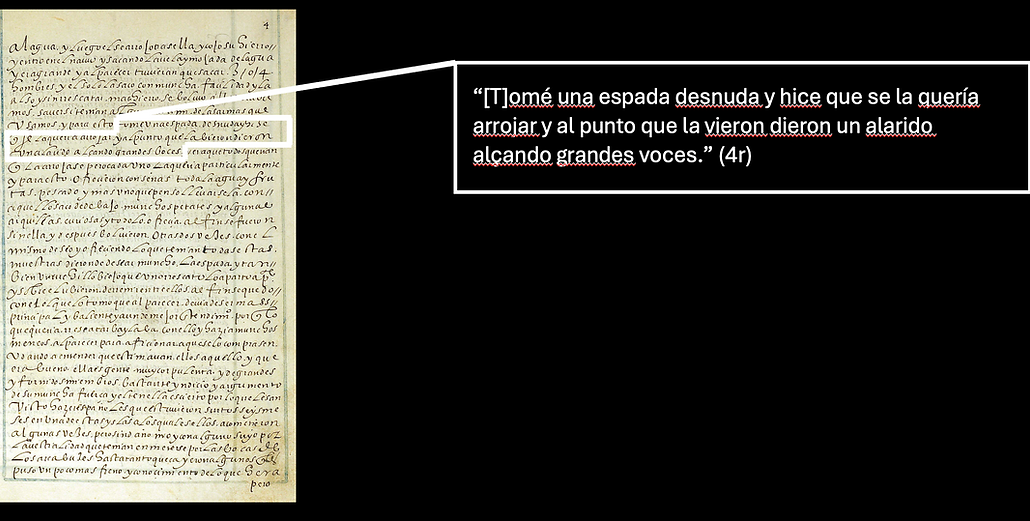
The author recounts, in first-person singular, an episode where he brandished a sword, mimicking a gesture as if to throw it, prompting a startled reaction from the Ladrones:
“[T]omé una espada desnuda y hice que se la querı́a arrojar y al punto que la vieron dieron un alarido alçando grandes voces.” (4r)
(Serratos 534)

"In the introductory image, twelve individuals aboard the galleon are actively engaging with the Chamorro people. On the galleon’s poop deck, two distinctive figures are visible, one of them wearing a hat adorned with feathers." (Serratos 535)
"Strikingly, the author, who is described as holding a sword aloft, is absent from the illustration. None of the twelve passengers are depicted holding any weapons." (Serratos 535)
This lack of evidence in the illustration strongly suggests that the artist and the author of the Ladrones narrative were likely not the same individual. If they had been, one might reasonably expect the artist to depict himself wielding a sword or otherwise emphasize his presence.
Works cited:
Serratos, Brayan. "Navigating the Spanish-Chamorro Transoceanic Encounter: Authorship and Collaborative Work in the Boxer Codex." Revista Canadiense de Estudios Hispánicos, vol. 48, no. 3, pp. 523–546, 2024 (published in 2026). https://doi.org/10.18192/rceh.v48i3.7145.